
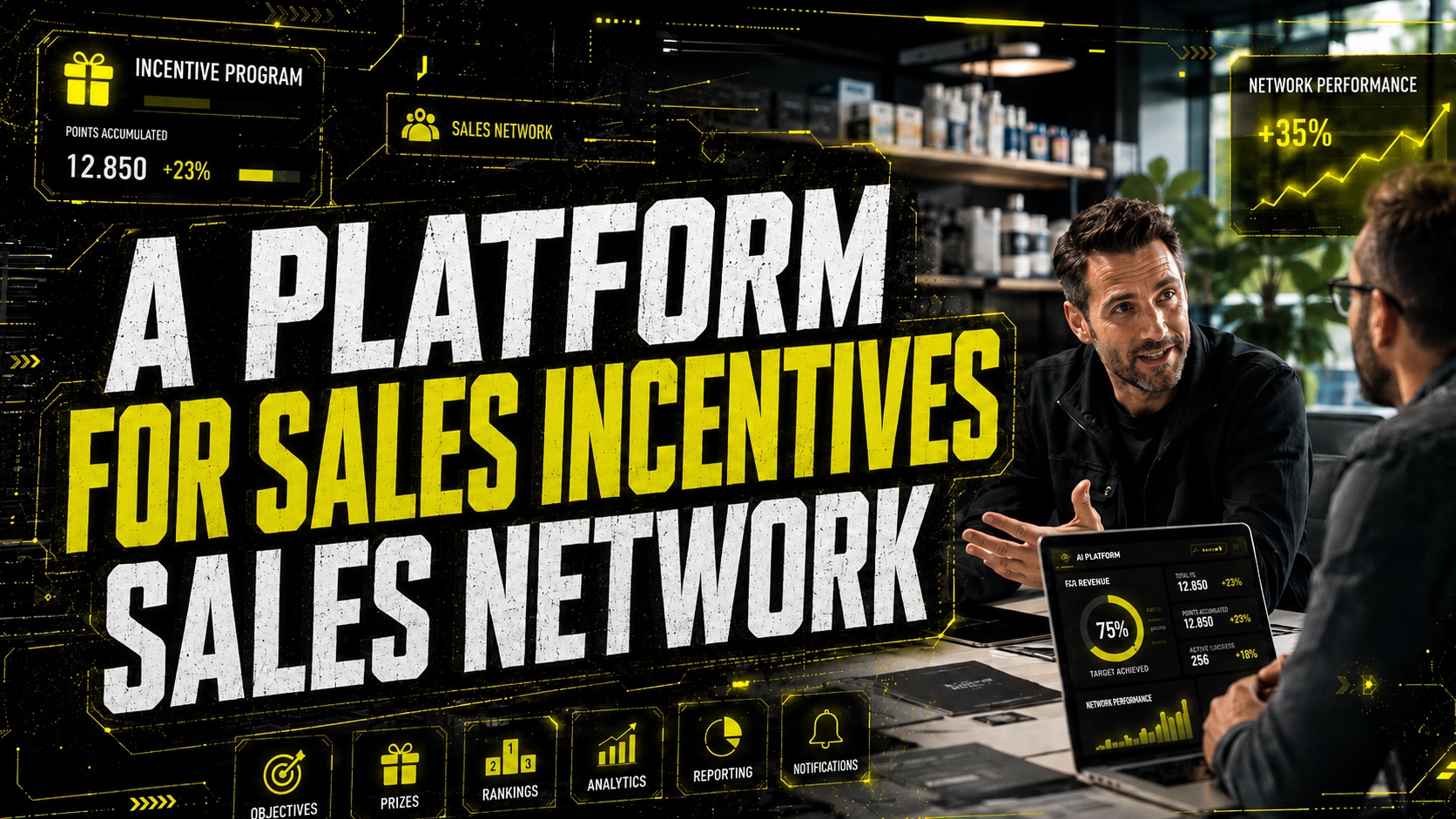
Take a manufacturing company with a direct sales network of twenty agents and an indirect network running through five wholesalers, each with their own salespeople. In total, the people who talk to your end customers every day are probably one hundred, one hundred and fifty, maybe more.
How many of them do you know exactly what they're selling right now? How many are pushing the premium lines? How many are about to hit their monthly target, and how many are already off track?
If the answer is "I don't know" or "I need to ask the sales manager, who then checks the data in the ERP," you've already identified the problem.
The real cost of managing incentives without the right tools
Sales network incentivization is one of the most effective investments in trade marketing. But it only works if it's managed with precision: personalized targets, clear mechanics, continuous monitoring, timely intervention when something goes wrong.
Doing it with Excel spreadsheets, periodic emails and monthly meetings always means arriving too late. The quarter is already over by the time you realize that ten customers didn't hit their target. Rewards are paid out on performance you couldn't influence in real time.
The result? Certain costs, uncertain results.
Direct network and indirect network: two problems, one single platform
The direct sales network is the one you control: your agents, your area managers, your sales managers. You can assign them targets, monitor them, train them, incentivize specific behaviors.
The indirect network is more complex. Wholesalers' salespeople don't report to you, don't attend your product meetings, and have no obligation to propose your products rather than a competitor's. Yet they have the final say with the end customer at the moment of the purchase decision.
Managing both networks with separate tools creates information gaps, inconsistencies in incentive mechanics, and makes it impossible to have a unified view of the channel. A dedicated AI platform solves this problem at its root, making the same ecosystem accessible to the entire supply chain.
What an AI platform actually does for incentivization
Customers & Targets.
Every customer, every agent, every wholesaler's salesperson has a personalized objective calculated on historical purchase data. Not a one-size-fits-all target, but an objective built on the real potential of that single account. The platform monitors progress in real time and flags who is at risk before the window closes.
Sales data and Statistics & KPIs.
Sales data stops being a monthly snapshot and becomes a continuous flow. Every transaction updates KPIs in real time: revenue by product line, progress toward the target, performance by geographic area, comparison between agents. The integrated AI Chat lets you query this data in natural language: "Which customers in the North area bought less than 70% compared to last year?" becomes a query solvable in seconds, without needing an analyst.
Loyalty & Collection, Contest & Giveaway.
The loyalty component builds customer retention over time, accumulating points on every purchase. Timed contests create sales peaks at strategic moments of the year, with competitive mechanics that boost network engagement. The two can coexist on the same account, with separate logic and distinct rewards.
Promotions & Bundles, Accelerators, Discounts & Rebates.
Product promotions are managed from the same platform: bundles built to push premium lines together with entry-level ones, accelerators that can be activated in low seasons to bring orders forward, end-of-period rebates automatically calculated on real purchase data. No manual calculations, no risk of errors.
Referrals and Influencer Marketing.
The sales network can also become an acquisition channel. Referral programs reward those who bring in new customers, organically expanding the commercial perimeter. B2B influencer marketing, still underused, makes it possible to engage key figures in the sector to amplify the launch of new products.
Sales opportunities and New Product Launches.
The AI analyzes the customer portfolio and identifies hidden opportunities: customers who buy some lines but not others, accounts with untapped upselling potential, under-penetrated geographic areas. Each new product can be launched with a dedicated mechanic, measuring adoption in real time across the entire supply chain.
The paradigm shift: from reactive to proactive
The limitation of any manually managed incentive system is that it is structurally reactive: you see the data at the end of the month, you intervene the following month, you wait for the end of the quarter to understand whether it worked.
An AI platform reverses this logic. Data arrives in real time, anomalies are flagged automatically, the area manager can act on the right customer at the right moment, not when performance is already compromised.
This is not a marginal advantage. It's the difference between incentivizing and truly managing the sales network.
The question I leave you with
How many hours a week does your sales team spend collecting data, updating reports and responding to requests about target progress?
Those hours could be spent selling. And the data could arrive on its own, updated in real time, without anyone having to ask for it.
The Salestack AI platform integrates targets, loyalty, promotions, training and product launches into a single ecosystem accessible to the entire network, both direct and indirect. No Excel spreadsheets, no delayed data, no end-of-quarter surprises.
Gianluca Testa
Founder Salestack
Host of the Business Garage Podcast