
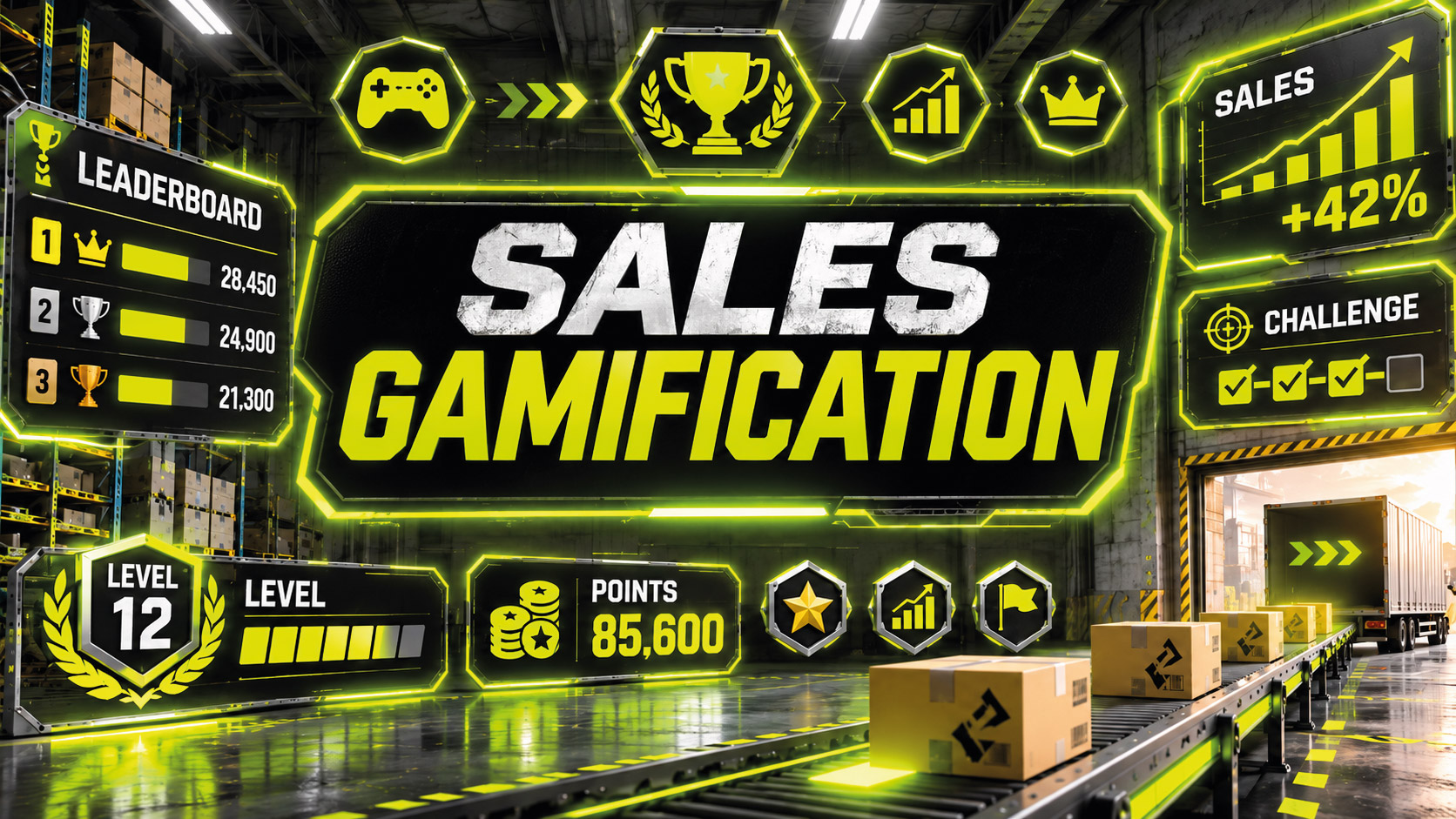
A leaderboard hanging on the office wall. At the top, always the same three names. At the bottom, always the same ten. In the middle, twenty people who stopped looking at it months ago.
This is gamification done badly, and it's the most common kind. Not because the idea is wrong: games work, and they work even with adults who sell for a living. But they only work if every participant has a game to play, not just the top of the class.
Let's look at the mechanics that work with a sales network, whether direct or indirect, and the mistakes that turn them into a boomerang.
What gamification applied to sales is
Gamification means using the rules of games in a context that isn't a game: points, levels, challenges, leaderboards, prizes, visible milestones. In sales it serves one precise purpose: making visible and immediate a result that would otherwise arrive late and in an abstract way.
Year-end revenue is far away. A challenge that ends on Friday, with your own name climbing the leaderboard, is close.
It's not a different rewards program: it's the way you tell its story and bring it to life day by day. The incentive program establishes what you earn; gamification decides how you get there.
The mechanics that work
1. Leaderboards within homogeneous groups. A single leaderboard always rewards whoever has the best territory or the biggest store. Split by tier, by zone, or by type of point of sale, it gives everyone opponents within their reach. Someone who's fifteenth out of fifty won't move; someone who's third out of eight will.
2. Leaderboards based on improvement, not absolute value. Rewarding those who grow the most compared to themselves, rather than those who sell the most in absolute terms, brings those who start behind back into the game. It's the mechanic that most often reactivates stalled salespeople.
3. Short challenges. One week, two at most, on a single goal: a product line, a number of new customers, a service to pitch. The brevity creates urgency and lets whoever lost the previous challenge start over right away.
4. Levels and milestones. Bronze, silver, gold; or point thresholds that unlock different prizes. Unlike a leaderboard, a level is reached without taking anything away from anyone else: everyone can reach gold. It's the most inclusive mechanic, and the most suited to indirect networks, where participants don't know each other.
5. Time-limited multipliers. Double points on a product for a month, or during the period when you need to push it. They give the network's effort a precise direction without changing the program's rules.
6. Personal goals. A sales target assigned to each customer or salesperson, with a bar showing how much is left. "You're €300 away from the bonus" works better than any leaderboard, because it speaks only to you.
7. Badges and recognition. The first order of a new line, a completed course, three months in a row above target. They cost little and give visibility to behaviors that revenue doesn't show, such as product training.
What doesn't work
The leaderboard where the same people always win. It motivates three people and discourages everyone else. If after a month the top positions haven't changed, the mechanic needs to be reconsidered.
Too many rules. If understanding how to earn points requires reading a ten-page rulebook, no one plays. Every mechanic has to fit in one sentence.
Prizes that arrive late. Gamification thrives on immediacy. Points that only appear at the end of the quarter, or prizes delivered six months later, kill the effect.
Rewarding what's easy to measure, not what matters. If you reward the number of orders, you'll get lots of small orders. If you reward visits, you'll get pointless visits. The mechanic has to be built around the real commercial objective.
Forgetting those who don't participate. In every network there's a portion that has never even logged into the portal. Gamification that speaks only to active participants leaves out precisely those who should be involved: it takes a targeted action, often from the agent or area manager, to bring them into the game.
Direct network and indirect network: two different games
With agents and in-house salespeople you can use leaderboards and team challenges: people know each other, compare themselves, and competition makes sense.
With the indirect network—that is, resellers, wholesalers' salespeople, counter staff, installers—direct competition works less well. They don't know each other, they work for different companies, and often they also sell competitors' products. Here levels, personal goals, multipliers, and prizes attainable by everyone work better. A leaderboard, if there is one, is better organized by zone or by banner.
In both cases, the game works if it's based on real data: what the network actually sells, not just what the company invoices to wholesalers.
How to tell whether it's working
Four numbers are enough.
- Participation: how many members of the network have logged in at least once, and how many are active in the last month. It's the first indicator, and the most neglected.
- Distribution of results: how many people have reached at least the first level or the first goal. If it's always the same few, the mechanic is exclusionary.
- Growth on pushed products: sales of the line that had the challenge or the multiplier, compared with the period before.
- Return on investment: additional margin generated versus the cost of prizes and management. We covered this in the article on how to calculate the ROI of an incentive program.
Where to start
- A single commercial objective for the first mechanic: a line to push, a zone to reactivate.
- An inclusive mechanic: levels or personal goals before leaderboards.
- Rules in one sentence and points visible immediately, from the phone.
- A short challenge after a month, to set a rhythm.
- A participation check every two weeks, agent by agent, to go looking for those who haven't logged in yet.
With SALESTACK every participant sees their points, their goal, and the active accelerators on their phone—that is, the products that earn extra points during that period; contests and instant wins add on to the same initiative. Whoever manages the network sees the leaderboard, who's participating and who isn't, under which agent, and can step in before the program fizzles out on its own.