
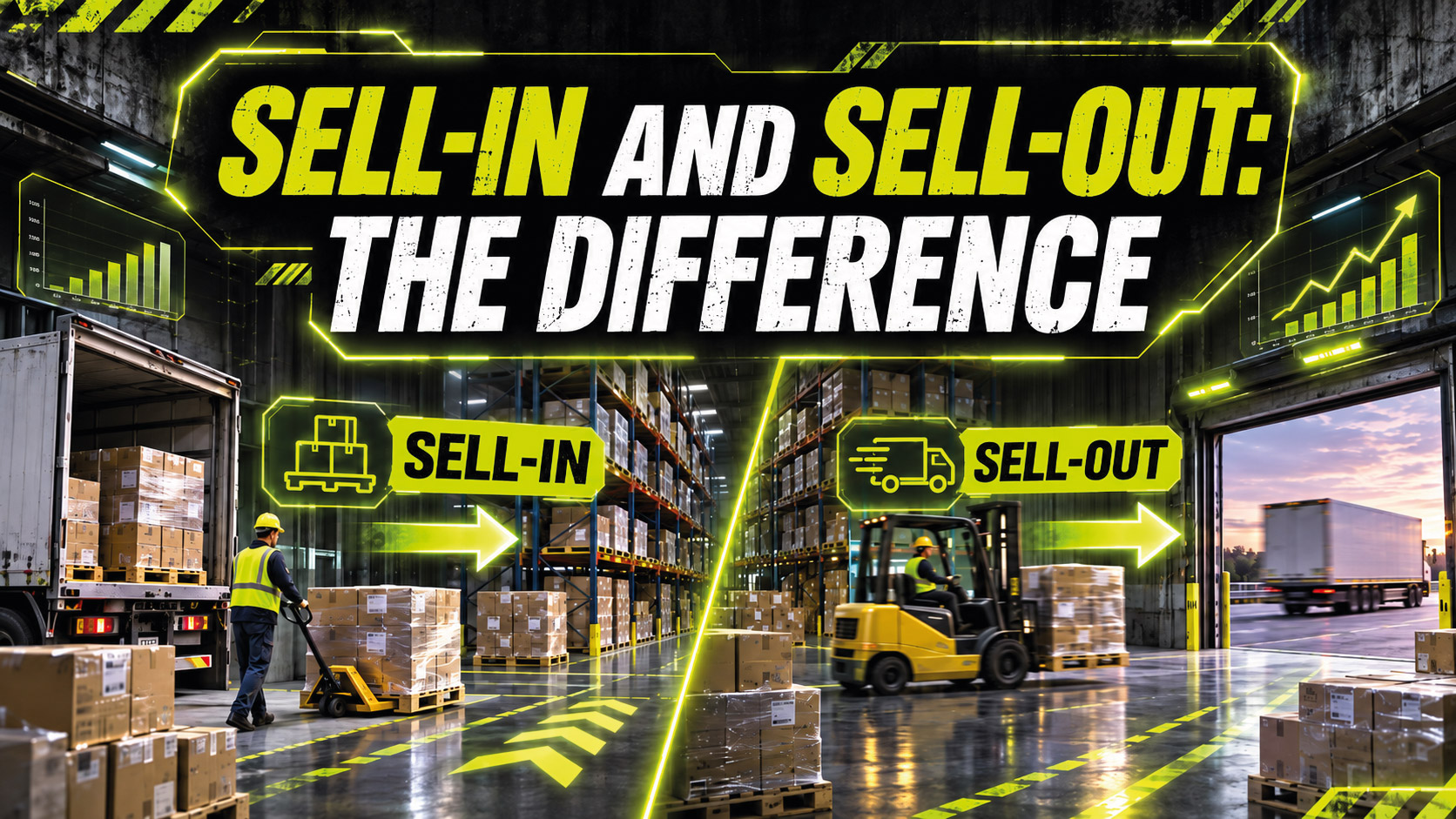
A wholesaler buys 100 units from you. Your revenue says things are going well. But over the next three months they only resell 60: the other 40 stay in the warehouse.
The next order will be smaller, or it will come later. And when it comes, they'll ask you for a discount to clear out what's sitting idle.
This is the difference between sell-in and sell-out. Those who sell through wholesalers and distributors almost always look at the first, because it's what ends up on the invoice. But it's the second that tells you how sales will go in the coming months.
What sell-in and sell-out are
Sell-in is what the company sells to its direct customers: wholesalers, distributors, chains. It's the number on your invoices. You know it down to the cent.
Sell-out is what those customers resell in turn: to the retailer, the installer, the end consumer. It's the number that tells you whether the product is really moving in the market. Usually you know little about it, or nothing at all.
In a long supply chain there are more than two levels. The manufacturer sells to the wholesaler, the wholesaler to the retailer, the retailer to the end customer. The sell-out of one level is the sell-in of the next:
| Step | For the manufacturer | For the wholesaler |
|---|---|---|
| Manufacturer → wholesaler | sell-in | purchase |
| Wholesaler → retailer | sell-out (first level) | sell-in |
| Retailer → end customer | sell-out (to consumption) | sell-out |
That's why, when talking about sell-out, it's always worth clarifying which level. What the wholesaler sells to stores and what stores sell to customers are two different things, and the second always comes later.
Why sell-in alone misleads you
Sell-in is a real figure, but it only tells half the story. Here are the cases where, on its own, it leads you astray.
End-of-period loading. To close the quarter, the wholesaler is pushed to buy more, with a discount or a special condition. Sell-in goes up, sell-out doesn't. The following quarter the wholesaler doesn't order, and the drop seems to come out of nowhere.
The swelling warehouse. If sell-in grows more than sell-out for several months in a row, the difference is goods sitting idle in the warehouses along the chain. Sooner or later it becomes a bottleneck: blocked orders, return requests, discounts to empty the shelves.
The product that doesn't turn. A new line can have excellent sell-in, because wholesalers put it in their catalog, and poor sell-out, because nobody offers it at the counter. Looking at sell-in alone, you judge it a success for months.
The network you can't read. Sell-in tells you how much the wholesaler buys, not which of their salespeople or customers push your product. Without sell-out you don't know where to intervene.
We also talked about this in the article on the 12 KPIs that tell you whether your sales are healthy: revenue is the most-watched number, but also the most delayed.
The indicators to watch
A few numbers are enough, read together.
1. Sell-out / sell-in ratio. How much of the goods sold to the channel was resold in the same period. Close to 100% the chain is in balance; consistently below, the warehouse is growing; above, the channel is burning through stock and will soon reorder.
2. Inventory coverage. How many days the goods the wholesaler has on hand will last, at the current pace of sell-out. Coverage that stretches out is the first sign of an order that will be skipped.
3. Turnover. How many times a year a product's stock is renewed. Two products with the same sell-in can have very different turnover: one sells itself, the other takes up shelf space.
4. Sell-out per point of sale and per salesperson. This is the most valuable figure and the hardest to get. It tells you who, within the wholesaler's network, actually sells your product and who doesn't. This is where training, incentives, and agent visits are decided.
5. Distribution. In how many points of sale the product is actually present and sold, compared to those that could sell it. Low sell-out often doesn't depend on who sells, but on who never started.
How to get sell-out data
You already have sell-in. Sell-out has to be sought out. There are four routes, and they're often used together.
The wholesaler's reports. Some distributors periodically send sales by customer or by area, in a file or through a data exchange. It's the best source when it exists, but it depends on their willingness: many don't do it, others do it late or at too aggregated a level.
Market measurements. Panels and market research estimate sales to consumption. They're useful mainly in fast-moving consumer goods; in technical supply chains (construction, plumbing and heating, electrical, furniture) they cover little.
Agent visits. The agent sees the retailer's warehouse and hears what's selling. It's valuable information but subjective, and it rarely becomes data that can be added up and compared.
Declarations from the network, with an incentive. This is the most underrated route. If the wholesaler's salesperson or the retailer earns points for each product sold, they have a reason to declare the sales, one by one, with the document that proves them. The rewards program thus becomes the way to collect the sell-out the wholesaler doesn't give you, down to the individual salesperson.
For the data to be reliable, it has to be checked: what a wholesaler's salespeople declare can't exceed what that wholesaler bought from you, that is, your sell-in to them. Sell-in thus becomes the ceiling that makes sell-out credible.
We discussed this in the article on what Alberto Brambilla of the Verdi wholesaler in Monza sells and in the one on the incentive program for retailers.
The most common mistakes
Comparing different periods. January's sell-in is compared with January's sell-out, but the wholesaler's warehouse has its own lag: it's better to reason in terms of quarters or moving averages than a single month.
Stopping at the total. A good sell-out/sell-in ratio on the total can hide a product that doesn't move and another that's doing great. It has to be read by product line.
Not telling the network why the data is needed. Asking the wholesaler or retailers for numbers without giving anything in return produces incomplete and late files. It works when the data also serves them: to see their own sales, to reach a goal, to earn a reward.
Collecting the data and not using it. Sell-out exists to help you decide: where to send the agent, who to train, which product to push with a promotion. A report nobody reads is just a cost.
Where to start
- Choose the sell-out level you need: wholesaler to retailers, or retailers to end customer.
- Calculate the sell-out/sell-in ratio for your three main wholesalers, even by hand, for the last quarter.
- Look at inventory coverage on your most important product lines.
- Decide how to collect sell-out per salesperson: wholesaler reports where they exist, incentivized network declarations where they don't.
- Connect the numbers to actions: those who don't sell get training or a visit, those who do get recognition.
SALESTACK was created for exactly this: it collects the sell-out declared by the network, checks it against each wholesaler's sell-in, and turns it into points, rankings, and signals for agents. This way you know what really sells, where, and thanks to whom, without waiting for revenue to tell you.