
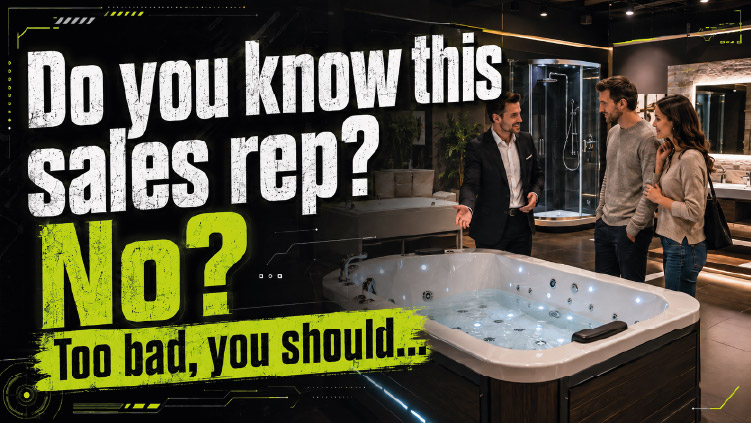
What if I told you that right now you don't have full control over your sales, and that you're probably financing your competitors?
I know, it sounds provocative. But bear with me for a moment.
Every year your company invests in research and development. It creates new lines, new products, improves the existing ones. The catalog grows, perhaps reaching tens of thousands of codes.
Then it invests in advertising and communication to make the products known, distribute them on the market, and generate demand from the end consumer—whether private or professional.
So far, so good. The problem comes afterward.
The exact point where you lose control
If your sales don't go through a proprietary channel—an e-commerce site or a network of your own stores—then they go through distributors and wholesalers.
Those wholesalers have their own salespeople: showroom staff in bathroom furnishings, counter clerks in electrical supply stores, interior designers in furniture stores, white-goods salespeople in large retail chains. People who talk to your end customers every day.
And here's where the problem arises: those salespeople know only a tiny fraction of your catalog, and they recommend even less.
Not out of ill will. It's because they have dozens of different catalogs to manage, from different suppliers, all pushing their own new products. The rational choice, for them, is to keep recommending the products they know well and are confident they can sell.
The result is that the most important interaction in the entire sales process—the one between the salesperson and the end customer at the moment of choice—takes place completely outside your sphere of influence.
An uncomfortable question
Do you know how much and what a single wholesaler buys? Of course you do.
Do you know what a specific branch of a structured wholesaler with a central purchasing office buys? That's already trickier.
But if I asked you what Mario Rossi, from wholesaler Y, at the Monza branch sells, would you be able to answer?
I'm afraid not.
And that's exactly the point. Despite significant investments in research, development, and communication, you have no concrete way to influence the moment when the end customer chooses what to buy.
Your advertising investment generates demand. But without control over the last mile, that demand can easily end up on a competitor's product.
The solution: train and incentivize those who have the final say
The principle is easy to state and hard to execute: you have to train and incentivize your wholesalers' salespeople, the ones who have the final say when they're in front of the customer.
In recent years it has become increasingly difficult to get salespeople to attend in-person technical training days. Time is short, priorities lie elsewhere, and no one can force them to attend, because they don't work for you.
The solution rests on three elements that must coexist. On their own, each of them produces modest results. Together, they completely change the dynamics of the supply chain.
1. The salesperson database: the bonus worth more than anything
The first element is a byproduct, but it may well be the most valuable benefit.
To get salespeople to take part in an incentive program, you have to register them. And when you do, you gain something you never had before: the complete list of the people who sell your products and who have the power to influence the customer at the moment of purchase.
Not only that. From that moment on, you and your network of agents will know exactly which products are being sold and which ones sit idle.
You'll discover that the distribution of sales is almost always patchy: in some areas certain lines do great, in others no one recommends them. And often this depends less on the market and more on how well the network is trained in that territory.
Being aware of these dynamics, and having the ability to act quickly, is a competitive advantage that your competitors are unlikely to have.
Then there's a second effect, less immediate but equally important: you build a direct relationship with your wholesalers' salespeople. You can tell them about new product launches, promotions, catalog updates. You can even send birthday wishes. Small gestures that, repeated over time, make you present in a channel where you were previously completely absent.
2. Commercial training, not technical training
The second element is training, delivered through an e-learning platform accessible anytime from a phone.
Pay attention to a point that many people get wrong: you don't need technical training, you need commercial training.
The salesperson doesn't need to know the product's complete specifications. They need to know three things: what sets your product apart from the competitor's, which type of customer it best suits, and how to respond to the objection that comes up most often.
A few concepts, clear and immediately usable. A long list of technical data convinces no one—neither the salesperson nor the end customer.
The format that works is the bite-sized one: short, focused content that can be consumed in a few minutes between one visit and the next.
3. Incentives: the concrete reason to take part
The third element is the one that holds everything else together.
Knowing what each salesperson sells, you can incentivize them by awarding points on the sales they make. And, crucially, training earns points too.
Every bite-sized lesson completed, every test passed, every material downloaded adds credits to the salesperson's balance, exactly like an order. Points accumulate and can be spent in an online rewards catalog.
The result is a virtuous circle: the salesperson trains because they earn points, and once they know the product they're much more likely to recommend it, increasing sales and earning even more points.
Training makes it easier to achieve results. The incentive rewards the results achieved. Together, they give you back control.
What changes today with AI
When I first devised this approach, the most laborious part was management: collecting sales data per salesperson, processing it, figuring out where to intervene, and doing it in time. Manual work that required dedicated resources and often arrived too late.
Today AI drastically reduces this complexity.
Automatic analysis of sales data. The data collected by the incentive program doesn't just sit in an archive: it's continuously analyzed to identify patterns, anomalies, and opportunities. Who sells only the basic products but has the potential for the premium lines. Which area is slowing down compared to neighboring zones. Which salespeople achieve significantly better-than-average results and what they're doing differently.
Proactive alerts. You no longer have to hunt for problems: they come flagged to you. A salesperson who has stopped ordering a product they used to recommend regularly becomes an alert, not a chance discovery at the end of the quarter.
Training content generated and personalized. AI can build the commercial bite-sized lessons starting from existing product sheets, adapting the level of detail to the salesperson's profile and training history.
Monitoring the training-sales correlation. The most interesting data point: do salespeople who have completed a specific lesson actually sell more of that product? With integrated data, this question has a measurable answer, and it lets you understand which content works and which needs rewriting.
The Salestack AI platform integrates training, gamification, incentives, and sales data analysis into a single ecosystem, accessible even to the indirect network of wholesalers. The principle is the same as always. What changes radically is the speed with which you can put it into play.
The question I'll leave you with
The objection I've heard most often in twenty years of consulting is always the same: "My product is high quality, it doesn't need these strategies. It should sell itself."
And my answer is always the same: why would you hand over market share to competitors who have lower-quality products but know how to use the levers of marketing better?
I never leave a door I could bolt shut merely ajar. Do you?
Gianluca Testa
Founder of Salestack
Host of the Business Garage Podcast