
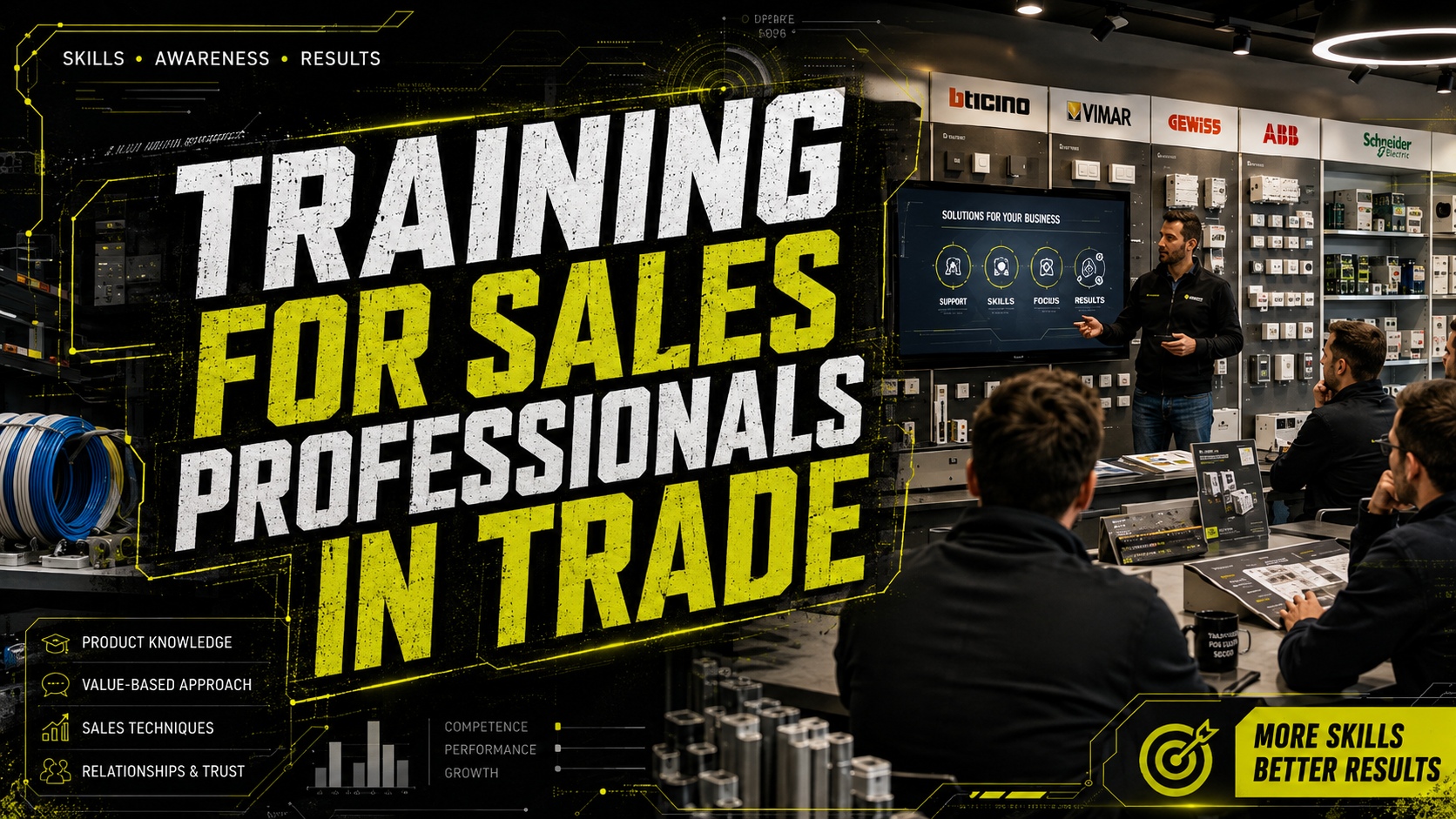
There's a scenario that repeats in almost every manufacturing company with a distribution chain.
The company launches a new product. It invests in research and development, builds a catalog, trains its own agents. Then that product reaches the wholesaler, who puts it in the warehouse. And there it stays.
Why? Because the wholesaler's salesperson, the one who talks to end customers every day, proposes what they know. The product they've sold a thousand times, the one they don't need to explain, the one that doesn't risk generating objections. Your new product, or your premium line, simply never comes up in the conversation.
This isn't a product problem. It's a last-mile training problem.
The knot few companies tackle: the indirect sales force
Manufacturing companies train their own employees. They have courses, product meetings, technical materials. But the sales force that truly has the last word with the end consumer, that of wholesalers and distributors, doesn't belong to them.
You can't summon them to a mandatory meeting. You can't impose a training path on them. You can't control what they propose to customers every day.
Or rather: you couldn't.
Because there's a mechanism that completely changes the dynamic: training and incentivizing at the same time, even the sales network that technically isn't yours.
Why salespeople always propose the same products
Before talking about solutions, it's worth understanding the mechanism behind the problem.
A salesperson, in any context, minimizes cognitive effort. It's not laziness: it's rationality. If you propose a product you know well, you know how to handle objections, how to position it, how to close. If you propose something new, you risk a question you can't answer and a sale that goes wrong.
The result is that best-selling products sell themselves, new offerings die on arrival, and premium lines remain in the catalog without ever being actively proposed.
Product knowledge is the prerequisite for the sale. Without it, no incentive really works.
E-learning that doesn't feel like e-learning
The word "training" immediately evokes endless slides, 45-minute videos, and boring final quizzes. None of that here.
The model that works in trade marketing is that of sales snippets: short content, focused on a single aspect of the product, built to answer the real objections salespeople encounter every day.
Not a list of technical data. Not product specs copied from the datasheet. But the three things a salesperson needs to know to propose that product with confidence: what sets it apart from the competition, who it best suits, what to say when the customer says it costs more.
Short video format, downloadable document as support, a final comprehension test. Fast, concrete, applicable the same day.
Gamification: when training becomes worthwhile
Training works if there's a concrete reason to do it. And this is where gamification comes in.
The mechanism is simple: incentive program points don't accumulate only by selling, but also by training. Every snippet completed, every material downloaded, every test passed adds points to the salesperson's balance, exactly like an order.
This creates a double effect. The salesperson has a concrete incentive to follow the training content. And once they know the product, it's much more likely they'll propose it, boosting sales and accumulating even more points.
Training and incentives feed each other. One without the other only works halfway.
The competitive advantage few are using
The combination of training plus incentives on the indirect sales force is one of the least widespread and most effective tools in trade marketing.
Most companies invest in incentives for sales and leave training to their internal channels. The result is that wholesalers receive rewards when they sell, but no one has ever given their salespeople a concrete reason to know your products better than the competitors'.
Those who instead integrate the two tools achieve something hard to replicate: a distributed sales force that technically doesn't depend on you, but that proposes your products with conviction because it knows how to do it and has an economic reason to do it.
How AI enters sales training
AI works on two fronts.
The first is content creation: generating training snippets from existing product datasheets, structuring them in the right format, adapting the level of detail to the salesperson's profile.
The second is monitoring: understanding who has completed the training paths, who doesn't yet have access to the materials, which content generates the most engagement, and which is abandoned halfway. This data allows for targeted intervention, both on training and on incentives.
The Salestack platform integrates training, gamification, and incentives into a single tool, accessible even to wholesalers' sales forces. Sales snippets, points for training and for sales, real-time progress monitoring.
The question I'll leave you with
Do you know how many of your wholesalers' salespeople have ever read a product datasheet for your new offerings in the past year?
If the answer is "very few" or "I don't know," you've already identified the exact point where your sales get stuck. And you know where to start working.
Gianluca Testa
Founder Salestack
Host of the Business Garage Podcast